
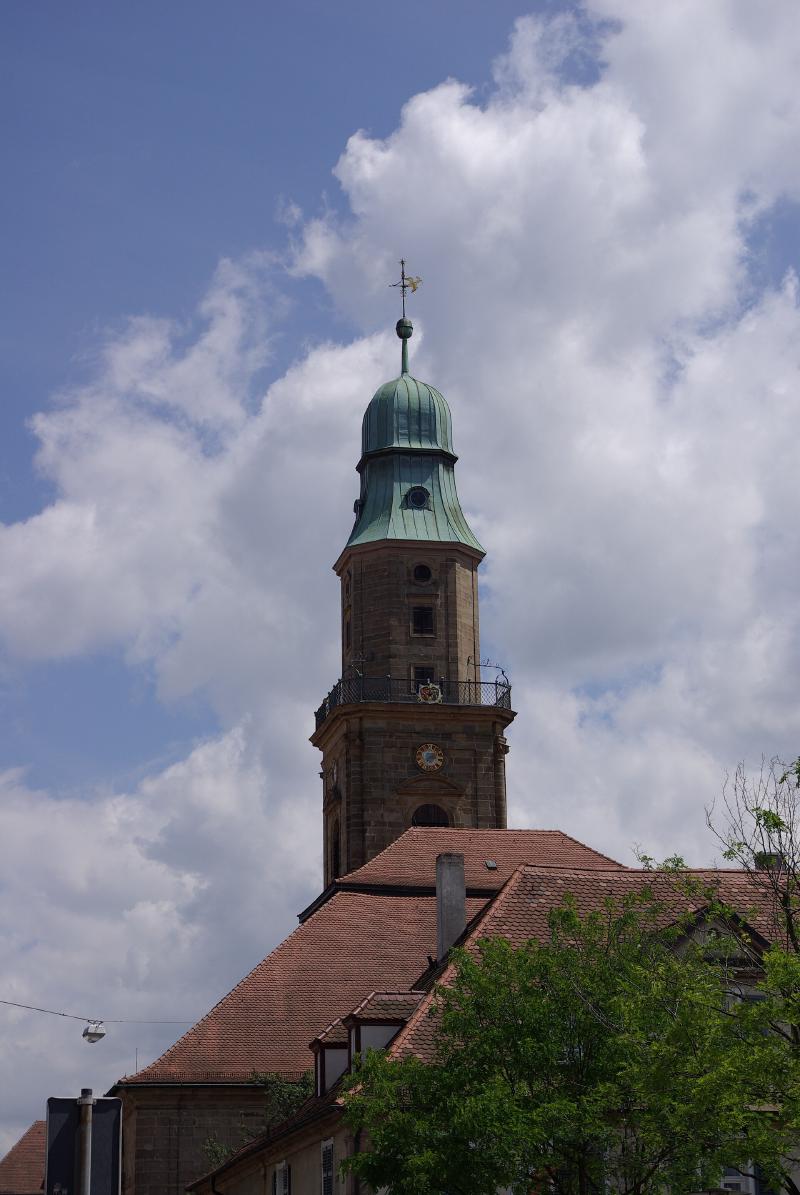
Erlangen does not show up on many people’s mental map of Bavaria, and the locals would rather it stayed that way - ask anyone in the Altstadt whether this is really Bavaria and brace for a lecture on Franconian identity you did not ask for. It is Middle Franconia’s university town, the smallest of Bavaria’s eight officially recognised Großstädte at just over 120,000 people, and home to both the second-largest university in the state and, depending on who is counting, the largest single Siemens site in the world. I was not born there and I did not stay: I arrived in 1984 to study Computer Science and left again in 1986 without finishing there, two years that were short even by student standards and that I have thought about disproportionately often ever since. This is not a hometown piece, then - it is closer to a two-year snapshot of a small city that has kept changing in ways I only found out about decades later.
The IMMD, and why Erlangen had computer science before most of Germany did #

Studying Computer Science in Erlangen in the mid-1980s meant studying at what was, by German standards, an old and established department rather than a new experiment. The Department Informatik - back then still the Institut für Mathematische Maschinen und Datenverarbeitung, or IMMD - was founded in 1966 by Wolfgang Händler, one of the people who a few years later helped draft the country’s first standardised Informatik degree programmes. That gave Erlangen close to two decades’ head start on universities that were still bolting Informatik onto their mathematics faculties when I enrolled, and it showed in how matter-of-fact the department already was about its own infrastructure and its own way of doing things. None of that felt historic while I was sitting in a terminal room finishing an assignment late at night; it just felt like the way things were done here. It took hearing other people’s stories of scrappier, newer departments, years later, to understand how much of a head start we had actually been given.
What that head start did not protect us from was sheer numbers. My own intake started at 586 people, roughly double what the department had actually been resourced to teach, and that gap between enrolment and capacity was not an abstract statistic - it was packed lecture halls, oversubscribed exercise groups, and a first round of examinations that a striking share of that year’s 586 did not get through. Studying under those conditions was genuinely stressful in a way that had nothing to do with the material itself, and it was made worse by something I only appreciated properly in hindsight: Bavaria had abolished independent student self-government - the verfasste Studierendenschaft that most other German states still had - back in 1973, over a decade before I arrived, and would not bring anything comparable back for another four decades. Students elsewhere in the country had a formal, funded voice in how their universities were run; in Bavaria we largely did not, which meant a genuinely overloaded intake had almost no institutional lever to push back with. I left in 1986 without a degree from Erlangen at all, transferring to continue my Computer Science studies in Cologne instead.
The Neustadt, planned for Huguenots who never went home #
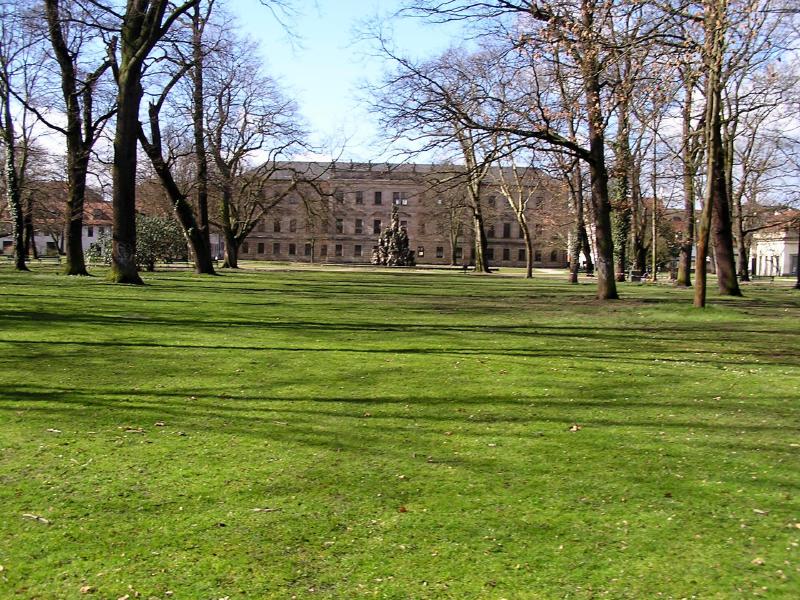
South of the old town is the Hugenottenplatz and the district built around it, laid out from 1686 onward as a purpose-built refuge for French Protestant refugees the Margrave Christian Ernst had invited to settle - an entire baroque planned town, complete with its own street grid and its own French Reformed church, built essentially from scratch for people who had just lost everything at home. It is one of the best-preserved baroque planned towns anywhere in Germany, and the Schlossgarten, laid out for the Margrave between 1700 and 1704 right next to it, is one of the oldest and most important baroque gardens in the country - genuinely impressive credentials for a city most people outside Franconia have never had a reason to visit. As a student none of this registered as remarkable; the Schlossgarten was simply the shortcut between the Altstadt and wherever the next lecture was, and the fact that I was cutting through three centuries of careful garden design to get there on time was not something anyone bothered pointing out.
Ferris Barracks, which stopped being an army base while I wasn’t looking #

For the two years I was in Erlangen, Ferris Barracks was still a fully working US Army garrison - a large fenced-off piece of the city with its own soldiers, its own PX, and its own rhythm that ran almost entirely separate from student life a few streets away. You noticed it mostly as a shape on the map and American accents in town on a Friday night. It had been a barracks under one flag or another since the late nineteenth century and stayed one under the American flag from 1945 until the base finally closed in 1994, eight years after I had already left; the memorial pictured above, on what is now Carl-Thiersch-Straße, marks the Erlangen Brigade’s own history as 1945 to 1991. What happened to the site afterwards is the part I only found out much later: the city bought roughly 101 hectares of former garrison land in the late 1990s, ran an international planning competition with over a hundred participating architects, and turned it into Röthelheimpark, a genuinely well-regarded modern residential district with around 5,000 people living there now, threaded through with its own park. A handful of the historic barracks buildings survived the conversion, repurposed for university and housing use rather than demolished. I have never actually walked through Röthelheimpark; the version of that ground I remember still has a fence around it.
Bruck, on the quiet side of the only bridge for miles #

I lived in Bruck, a district south of the centre that only became part of Erlangen in 1924 and still, even now, has its own identity distinct enough that some locals half-jokingly call it “Brucklyn.” It exists in the first place because of the Regnitz: for centuries this was the only bridge crossing the river between Vach and Baiersdorf, which made Bruck a genuine trading village in its own right, with draymen and innkeepers and, at various points, up to four breweries of its own, long before Erlangen absorbed it. The old village core survives around the fortified parish church of St. Peter und Paul, pictured above, whose defensive wall - up to five and a half metres high on the side facing the Regnitz valley - is still standing, with a tower finished in 1475 after the first version was damaged in the First Margrave War of 1449. The rest of Bruck, where I actually lived, was less picturesque: postwar apartment blocks and a settlement originally built for workers at the ERBA cotton mill, close enough to the motorway that Bruck had lost most of its village character before I ever got there. I liked it anyway. It was cheap, it was a short ride from the Altstadt, and coming home past a five-hundred-year-old fortified church on the way to a 1960s apartment block felt, at the time, like a completely unremarkable way to live.
The Pleitegeier, and the Kitzmann that isn’t brewed here any more #
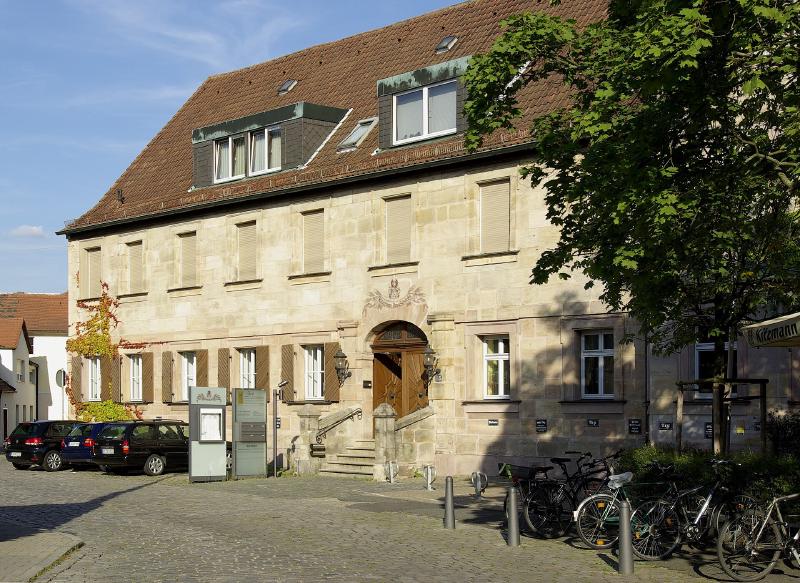
Student nights in Erlangen mostly meant one of a handful of Kneipen in the Altstadt, and Zum Pleitegeier on the Hauptstraße was the one that has, remarkably, not changed its basic character in the forty years since: still rustic, still a mixed and slightly chaotic crowd, still doing pizza and beer at student prices, with the banana pizza apparently still a running joke people bring up unprompted. What we were drinking there, more often than not, was Kitzmann - a beer brewed a short walk away at the Kitzmann-Bräu on the southern town wall since 1833, by a family that had been brewing somewhere in Franconia since 1733 and that outlasted every other Erlangen brewery after Nuremberg’s Patrizier-Bräu shut its local site in the mid-1970s. That run ended in 2018, when the last Kitzmann sold the brand rights to a brewery in Kulmbach and closed the Erlangen site for good; the beer still exists, technically, but it has not actually been brewed in Erlangen since. The Pleitegeier is still there. The beer we drank in it, brewed a few streets away, is not - which is a strange thing to feel nostalgic about, but here we are.
The Bergkirchweih, older than Oktoberfest and in no danger of stopping #
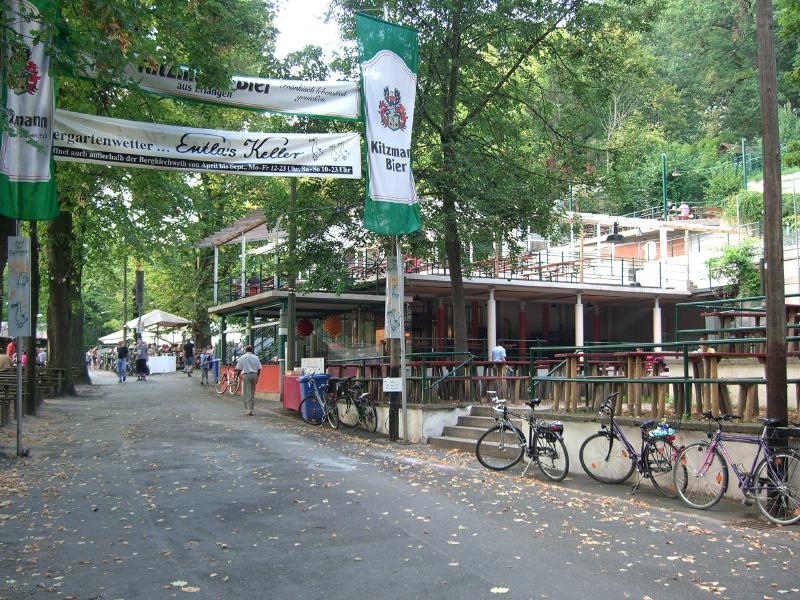
If there is one thing from those two years that has not changed at all, it is the Erlanger Bergkirchweih - the Berch, to anyone who has actually been. It dates back to a magistrate’s decision in April 1755 to move the town’s Whitsun market up onto the Burgberg, which makes it more than fifty years older than Munich’s Oktoberfest and one of the longest continuously running folk festivals anywhere. The reason it happens on that particular hill is entirely practical: brewers had been tunnelling beer cellars into the sandstone slopes since the late seventeenth century because the rock stayed naturally cool, and the resulting Kellerwald of cellar entrances and chestnut-shaded terraces, Entla’s Keller among them, is still where the whole twelve days happen every year around Pentecost, drawing something like a million visitors now. I went, obviously, more than once during those two years, sitting at long communal tables under the trees with a Krug in front of me and no particular plan beyond staying there until the Krug was empty again. Forty years on, the festival does not appear to have needed a single thing from me to keep doing exactly that.
Two years is not enough time to claim a place the way I can claim the towns I actually grew up in - but it turned out to be enough to leave a permanent groove: half the beer names, half the street names, and an oddly specific memory of a fortified church next to a fenced-off army base, neither of which I would have predicted mattering to me forty years later. Ferris Barracks is a park now. Kitzmann is brewed in another town. The Pleitegeier is still open, and the Bergkirchweih still happens every year on schedule, and between those two facts, Erlangen has done a better job of staying recognisable than most cities get four decades to try.